

Children’s Dental Care Tips for Healthy Daily Routines
Good children’s dental care starts with a manageable routine: brush twice daily, use toothpaste suited to your child’s age and help with cleaning until they can do it thoroughly. Regular meals, plain water and dental visits based on individual needs also support oral health. You do not need an elaborate system, but the routine does need to change as your child grows.
Build the day around two brushing times
Attach brushing to something that already happens each morning and evening. For example, morning brushing might come before getting dressed, while evening brushing happens before the bedtime story. A predictable order can reduce the daily negotiation about when to start.
| Daily moment | Practical approach |
|---|---|
| Morning | Brush all tooth surfaces using an age-appropriate toothbrush and toothpaste. Leave enough time for an adult to help. |
| During the day | Offer regular meals and snacks rather than continuous grazing. For toddlers and older children, make plain water the usual drink between meals. |
| Bedtime | Brush after the last food or drink, apart from water. Keep the routine calm and allow time to clean the back teeth. |
For children with several teeth, aim for around two minutes of brushing. A timer or familiar song can help, but reaching every surface matters more than simply waiting for the timer to finish.
Brushing removes plaque, the sticky layer of bacteria that collects on teeth. Fluoride toothpaste helps strengthen the tooth’s outer surface, called enamel. These measures reduce decay risk, but they cannot guarantee that a child will never develop a cavity.
Choose toothpaste according to age
Toothpaste selection is an important part of children’s dental care because young children may swallow it rather than spit it out. Check the packaging for the fluoride concentration and age guidance, rather than choosing by flavour or cartoon character alone.
The Australian Dental Association’s patient resource, Teeth.org.au, provides information about fluoride and children’s oral health. The usual Australian age-based approach is:
| Child’s age | Usual toothpaste guidance | Adult’s role |
|---|---|---|
| From the first tooth to under 18 months | Brush with a small, soft toothbrush and water, unless a dental professional advises otherwise. | Gently clean the teeth twice daily. |
| 18 months to under 6 years | Use a pea-sized amount of low-fluoride children’s toothpaste, generally 500–550 parts per million. | Apply the toothpaste, help brush and encourage spitting when the child can manage it. |
| 6 years and older | Use standard fluoride toothpaste, generally 1,000–1,500 parts per million, unless advised otherwise. | Continue helping or checking brushing according to the child’s skills. |
“Parts per million”, often written as ppm, describes the fluoride concentration. Your dentist may recommend a different approach if your child has a higher risk of decay or particular health needs.
Encourage children to spit out excess toothpaste when they are able and avoid rinsing with water afterwards. Keep toothpaste out of reach between brushing sessions to reduce the chance of it being eaten.
Hands-on support for children’s dental care
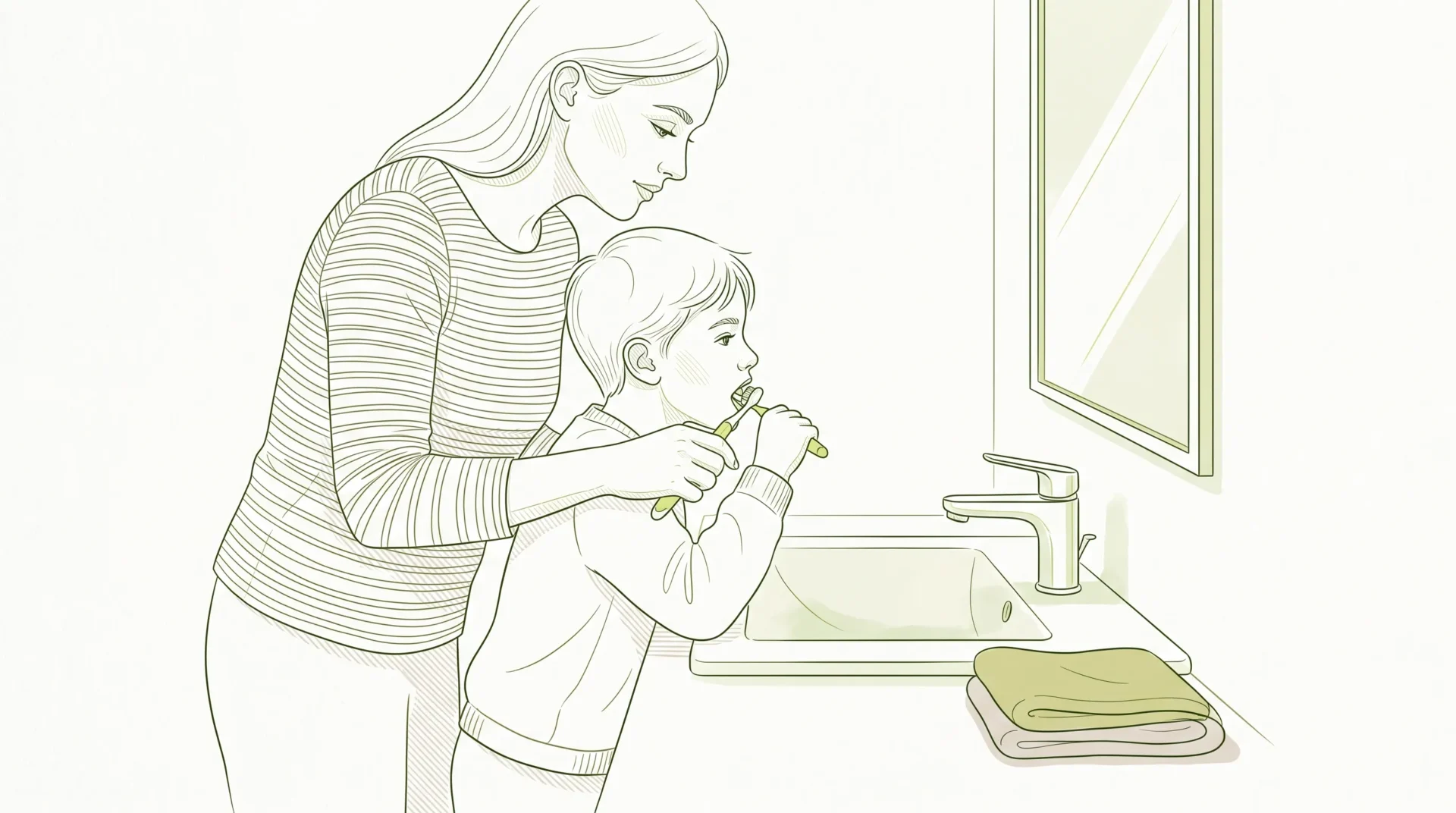
Being able to hold a toothbrush is not the same as being able to clean every tooth. Many children need an adult to brush or finish brushing until around eight or nine years of age, and some need support for longer.
Try standing behind your child with their head gently supported against you so you can see into their mouth. Use a small, soft-bristled brush and gentle movements along the gumline, where teeth meet the gums.
Work around the mouth in the same order each time, cleaning the outside, inside and chewing surfaces. Give the back teeth their own attention rather than assuming they have been reached during a quick sweep.
Letting your child have the first turn, followed by an adult’s finishing turn, gives them practice without handing over the whole task too early. Replace the brush when its bristles become worn or splayed.
Add cleaning between teeth when they touch
A toothbrush cannot thoroughly clean the tight spaces between touching teeth. Once neighbouring teeth touch, ask your dentist to show you how to clean between them with floss or an appropriate floss holder.
An adult will usually need to do this for younger children. Guide the floss gently rather than snapping it into the gums, and keep floss holders out of reach when they are not in use.
If gums repeatedly bleed, or cleaning seems painful, arrange a dental assessment rather than assuming the child simply dislikes the task.
Make difficult brushing moments more manageable
Refusing to brush can reflect tiredness, sensitivity to taste or texture, discomfort or a wish for more control. Children’s dental care is easier to adapt when you work out which part of the routine is difficult.
Offer limited choices without making brushing optional. Your child might choose between two suitable toothbrushes or decide whether brushing happens before or after putting on pyjamas.
Other adjustments worth trying include:
- Brushing earlier in the evening, before your child becomes overtired.
- Practising opening the mouth and lifting the lips briefly outside brushing time.
- Using a quieter space if bathroom noise or bright lighting is uncomfortable.
- Asking a dentist about a milder-tasting fluoride toothpaste if taste is the main barrier.
Avoid turning brushing into a threat or promising that dental care can never feel uncomfortable. If resistance begins suddenly, check whether there may be pain, an ulcer or another problem needing assessment.
Children with sensory sensitivities, disability or additional support needs may benefit from an individual plan developed with their dental team.
Keep food and drink habits simple
How often teeth are exposed to sugar matters, as well as how much sugar is consumed. Bacteria in plaque use sugars to produce acids that can damage enamel. Frequent sipping or grazing gives teeth repeated exposure throughout the day.
For children’s dental care, a useful starting point is regular meals and planned snacks, with plain water between them. There is no need to label foods as “good” or “bad”, but it helps to understand which habits create repeated sugar exposure.
Whole fruit is generally a better everyday choice than juice. Fruit juice, smoothies and sweetened drinks can contain sugars and acids even when their packaging sounds healthy. Plain milk can be part of a balanced diet, but avoid settling a child to sleep with a bottle of milk or juice.
Fluoridated tap water supports dental health. If your family mainly uses bottled or filtered water, ask your dentist whether this affects your child’s fluoride exposure. Some filtration systems remove fluoride, while others do not.
Healthdirect’s information about tooth decay explains how sugar exposure, plaque and fluoride relate to decay risk.
Check the routine as new teeth arrive
Around six years of age, the first permanent molars usually appear behind the baby teeth. Because no baby tooth falls out first, these new teeth can be easy to overlook.
Check that the toothbrush reaches right to the back, especially while a molar is only partly through the gum. Your dentist can assess whether additional preventive care, such as fluoride varnish or fissure sealants, may be appropriate. Sealants are protective coatings placed in the grooves of selected teeth; they are not needed by every child and still require monitoring.
When school schedules change, keep the same core brushing anchors. Our family dental health tips for busy school terms offer practical ways to fit these habits around school-day demands.
Know when a routine needs professional support
Home routines are only one part of children’s dental care. A dental examination is appropriate if you notice ongoing tooth pain, repeated gum bleeding, a broken tooth or a change in how your child eats or chews. White, brown or dark marks on teeth also deserve assessment, although their appearance alone does not establish a diagnosis.
Facial swelling, fever with dental pain or a dental injury needs prompt professional advice. Difficulty breathing or swallowing requires emergency medical care; call 000.
Dental visit intervals should reflect your child’s oral health, development and decay risk rather than a schedule assumed to suit everyone. At an appointment, the dentist can review brushing technique, toothpaste choice and any areas that are being missed.
If treatment is recommended, ask about the reasons, potential benefits, risks and alternatives before deciding.
Frequently asked questions
When should my child first see a dentist? Australian dental guidance recommends a first visit when the first tooth appears or by the first birthday, whichever comes first. Our guide to preparing your child for their first dental visit explains how to approach that appointment calmly.
Does my child need an electric toothbrush? Not necessarily. A manual or electric toothbrush can be suitable when it has a small head and soft bristles and is used thoroughly. Choose an age-appropriate option your child can tolerate, and continue adult assistance where needed.
Do baby teeth need treatment if they will fall out anyway? Sometimes. Baby teeth help with eating and hold space for developing adult teeth. Decay can cause pain or infection before a tooth is due to fall out. The dentist will assess the tooth, your child’s age and symptoms before explaining suitable options.
Discuss a routine that suits your child
For families in Toorak and nearby Melbourne suburbs, children’s dental care should be practical and suited to the child’s needs. If you would like advice about brushing, toothpaste or a concern you have noticed, you can arrange an appointment with Toorak Village Dental Care. Bring the toothpaste and toothbrush you currently use so the team can discuss them with you.
Disclaimer
The information provided on this website is for general informational and educational purposes only. It is not intended to replace professional dental advice, diagnosis or treatment. Dental needs and treatment outcomes vary between individuals. Always seek advice from a qualified dental practitioner regarding your specific circumstances before making decisions about your oral health or treatment. A consultation and clinical assessment are required to determine which treatment options may be suitable for you. All dental procedures carry potential risks and benefits, which will be discussed with you before treatment.